
The Goods is my running list of what’s caught my eye lately: shows, essays, artists, decor. Some things will push your collecting eye, some will just be good to know, and all of them shape how I’m thinking about art right now. It all ties back to the idea that taste is a moving target. What matters is building the muscle to notice, and then notice again.
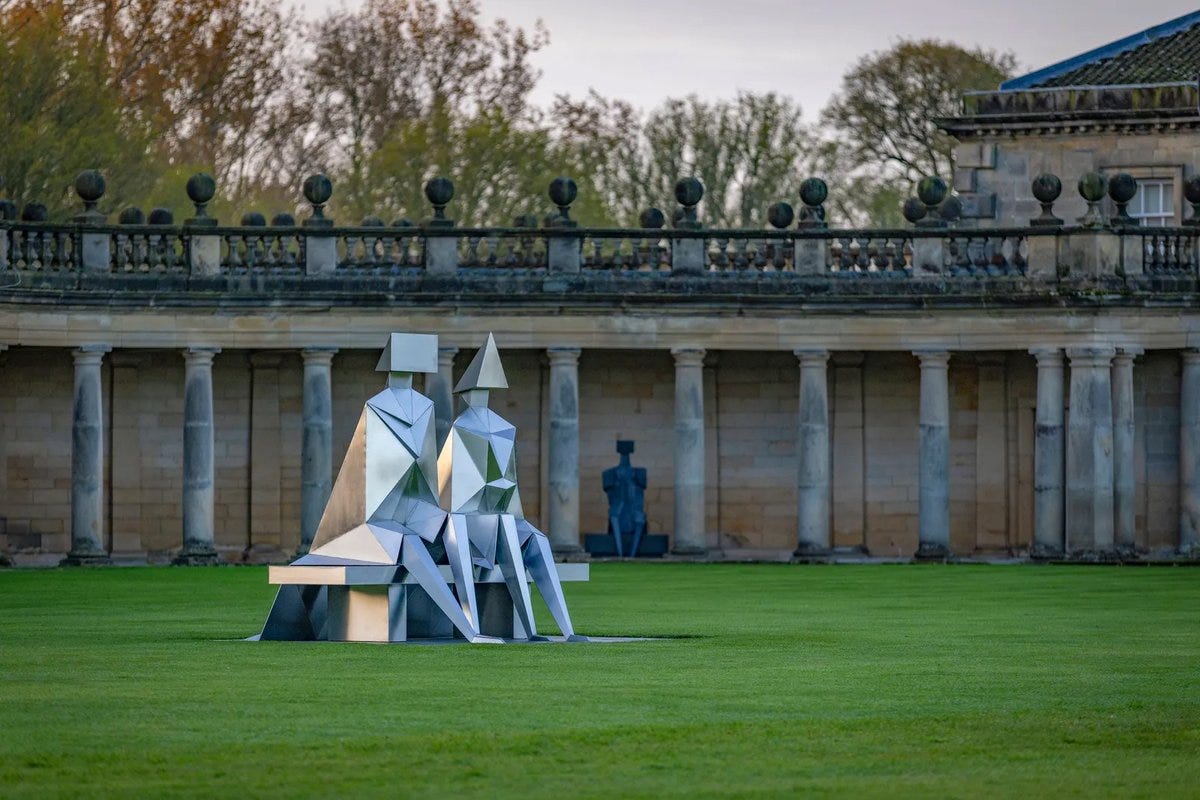
Before starting my art advisory, I worked at Tala, a microlending startup offering financial access in developing countries. And when I first started I didn’t understand why my credit and risk counterparts wanted MORE FRICTION as our customers turned in their loan applications. Onboarding was meant to be sleek, fast, and easy. Optimize that funnel. More people. More apps. More loans! Why would I make our customers work harder to get the thing we promised them?? Turns out, if we didn’t add friction we would loan money to people who couldn’t easily repay their loans - bad for the customer and bad for business. Oh, well then. Pass me some more friction please!
Today in my world of art and design I am noticing the same thing my risk team warned me about - some really good friction has been removed. There is more conventionally beautiful stuff available than ever. I can open Instagram, Pinterest, Substack, 1stDibs, TRR, etc. etc. and find a perfectly good version of what I’m looking for. A low kid-friendly coffeetable. A sculptural lamp. A purple top. A pair of black bermudas to take into fall (All items on MY literal list).
Part of the reason is access and the other part is as the stylist, JULIANA SALAZAR, so perfectly put it earlier this week, “everyone is making the SAME SHIT”. More things, but somehow fewer real choices.
When the markers of good taste become instantly searchable, shoppable, and reproducible, they start to lose some of their power. The object can remain beautiful. The room can remain elegant. The clothes can remain exquisitely made. But the choice no longer tells you very much about the person who made it.
Just scroll through the plethora of kinda chic posts that were trending last month.
The boredom of correctness
I started thinking about this more while having a case of the shoppies and looking back at all of my screenshots from fashion shows, Substackers I love, and threads I’m starting to see as we enter Fashion Month. Color is returning after years of beige, black, cream, and quiet luxury in some bold, fun, unexpected color combinations: red & purple, teal & red, orange & light green, moss green & light blue, cobalt blue & red clay. The combinations feel slightly wrong on purpose. They create temperature shifts, a moment of surprise, and of course, visual friction.
Watch a trend cycle for long enough and you’ll see the pendulum swing the other way, but I don’t think the shift here is as simple as minimalism to maximalism or from neutral to brights. There’s something else brewing below the surface that is making its way through culture - everyone is suspicious of anything that feels too optimized, so we pull a little in something undone, weird, and simply exciting.
In her fantastic midyear macrotrend update, ANU shared Aspirational Humanity as the leading macrotrend in the first half of 2026, which she defined as an appetite for imperfection, aging, handwork, realness, and forms of creativity that carry visible evidence of a person. I loved this line from her post: “Perfection becomes less desirable when it is too easily accessible.”
Obviously this has been super charged by AI, but for years, search, social media, recommendation engines, global commerce, flattening of cultures, and highly responsive supply chains have been teaching us what performs, what sells, and what looks right. The system identifies a successful aesthetic, distributes it, copies it, and then feeds its ubiquity back to us as evidence of desirability.
The result is the sleek sameness that starts to feel boring.
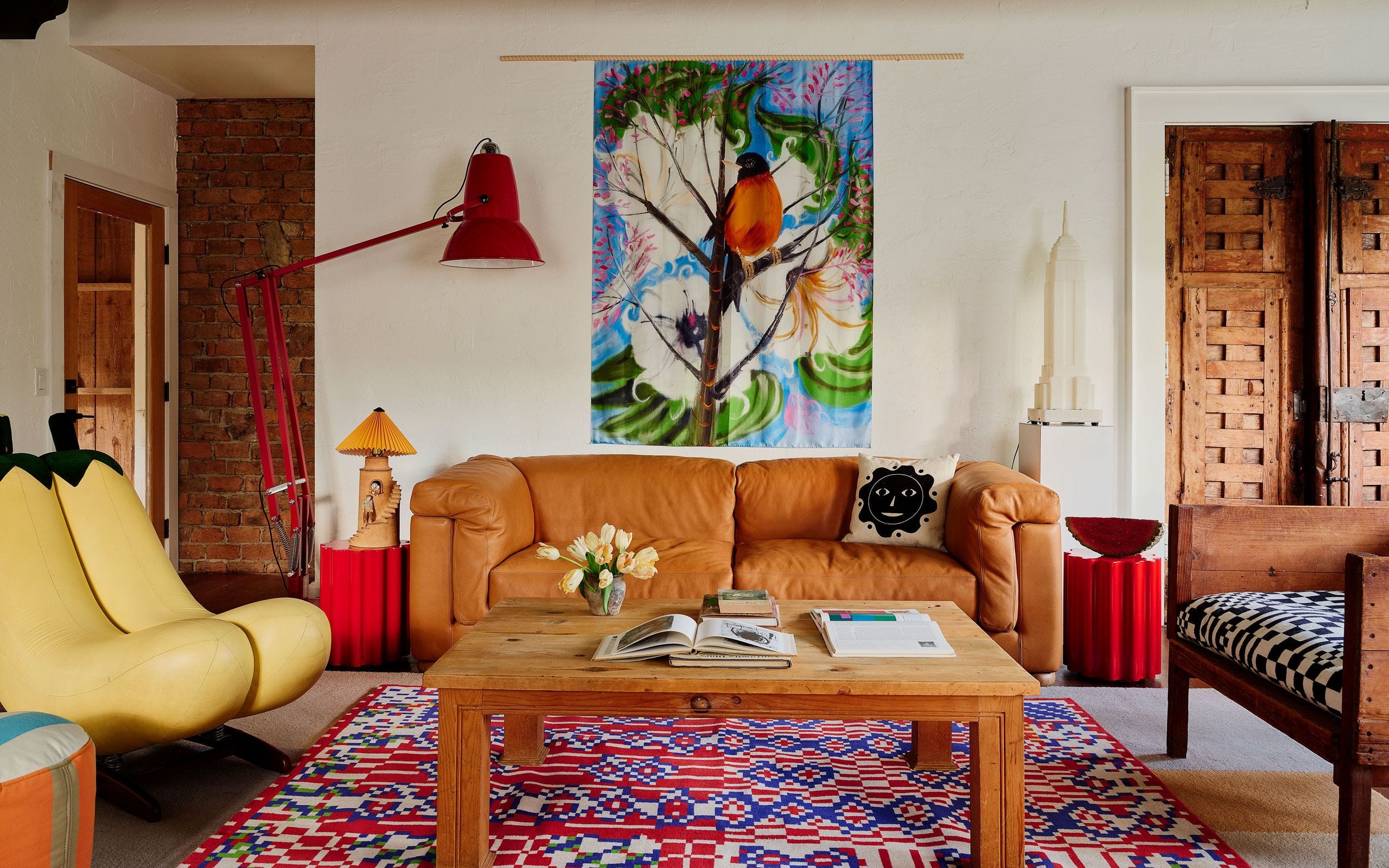
An Architectural Digest essay from last week, Good Taste is Getting Weirder, describes a similar shift in interiors. The article highlights replacing beige interiors with something “weirder” - rooms with humor, historical awareness, patina, inherited objects, and combinations that resist immediate recognition of taste.
Optimization has made “kinda chic” taste abundant. What is becoming scarce, and therefore desirable, is evidence of a person’s history, their specific idiosyncrasies, the friction that makes them who they are.
Taste needs human interaction
I loved this recent conversation with Rachel Karten with writer and researcher Ruby Justice Thelot about whether brands can have taste. Thelot talks about how historically taste moved through small networks of people and places. Social media may sound social, but increasingly behaves more like mass media - closer to watching TV (WITH the ads) than a friend showing you something.
Taste is created in the smaller moments - the store you wander into, the album playing at a party, the thing a friend tells you about that you never would have found on your own. It is shaped by friction, randomness, and human interaction.
This ties directly to another paper I read, by sociologist Neal Caren, “The End of Friday Nights with Friends.” Using American Time Use Survey data, Caren found that Americans’ weekly in-person time with friends fell from roughly 350 minutes in the early 2000s to 170 minutes in the early 2020s. Friday night, once a distinct social peak, now looks much more like an ordinary weeknight.
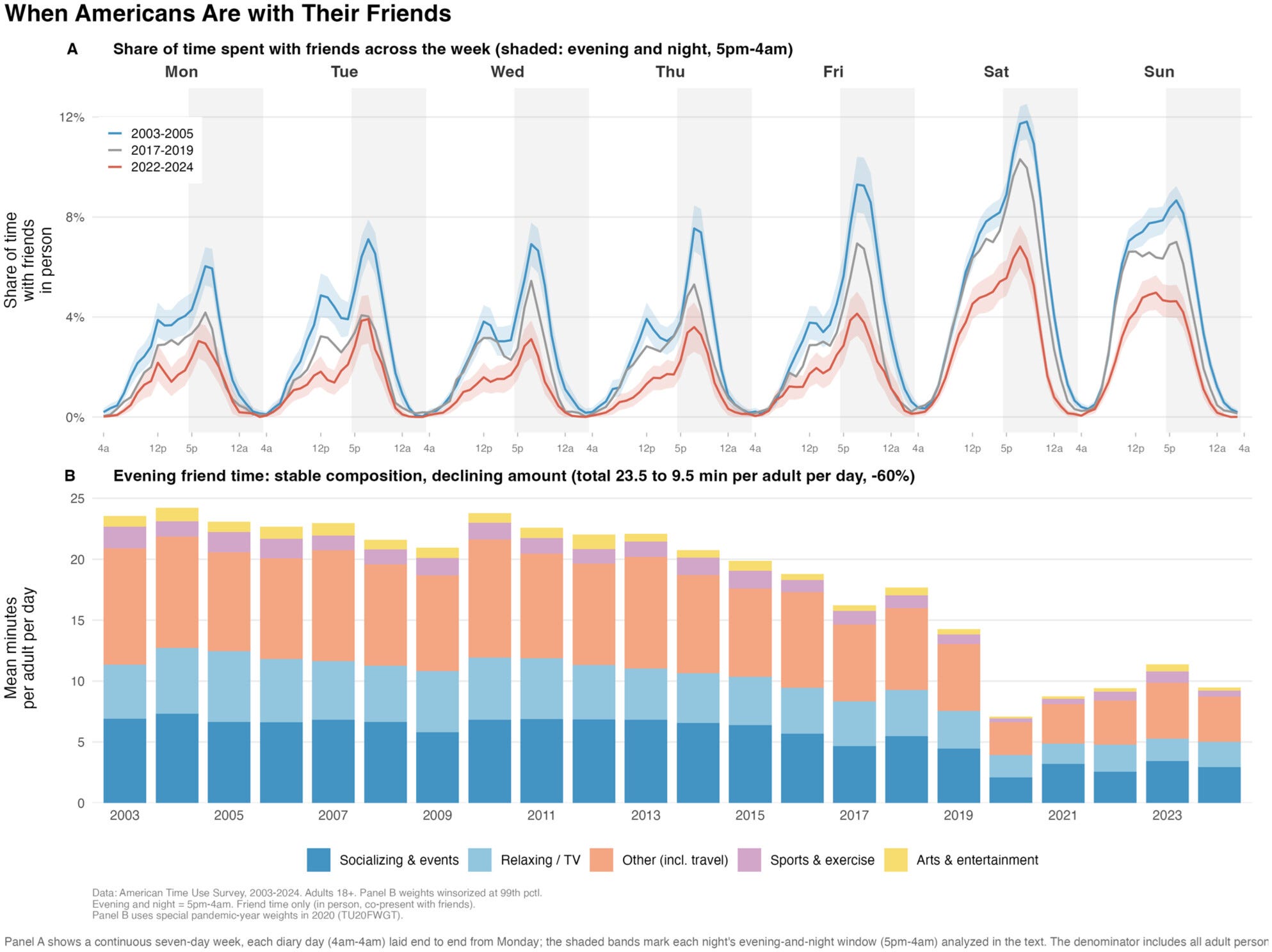
This doesn’t feel distinctly new (see the loneliness epidemic), but it documents the decline of in-person social life through which preferences and references have traditionally been created. You still get the album. You just don’t get the party, the conversations and the memories tied to it.
There is joy in friction, there is feeling in friction, and there is taste in friction.
The value of friction
Of course, weirdness will become a template that the algorithm and AI will optimize. “Human” will become a marketing treatment as easily as “minimal.” We are already seeing this in the number of luxury houses using artists for their ads.
So the useful distinction is not tasteful versus weird. It is template versus decision.
The sci-fi author Neal Stephenson believes AI will have a hard time actually replacing forms of art , like writing, fine art, and design, because art lives in the friction, constraints, and conventions that lead a person to make hundreds of micro-decisions. A creator pulls their ideas, experiences, and values into those decisions in a way that is truly one of one. AI is built for scale with one prompt and a sleek output. It is built for the middle, not the exceptional. (Side note: The reality is that the middle will be acceptable to many, but that is a different argument).
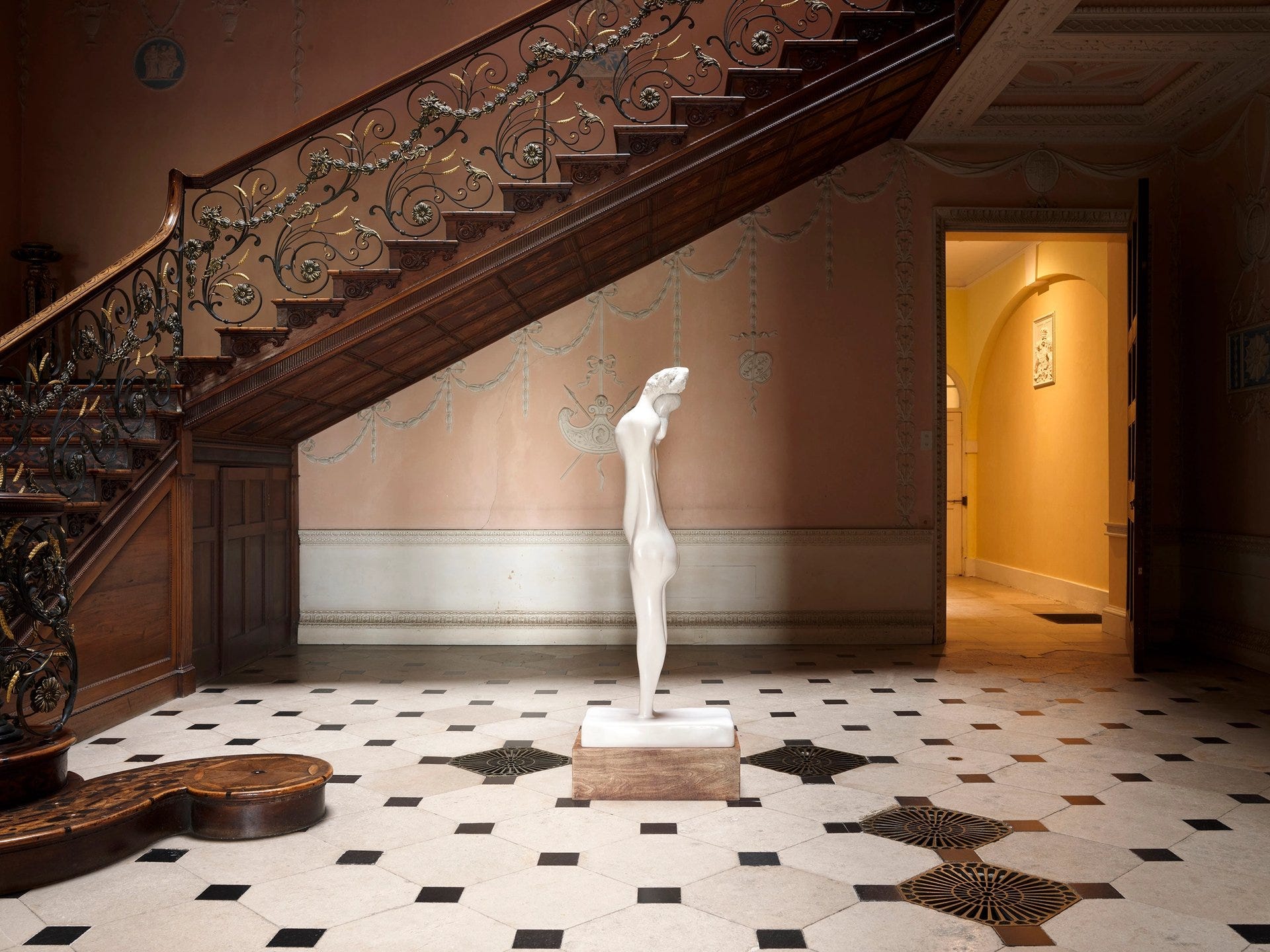
A recent Art Newspaper story looked at the growing number of Britain’s historic houses inviting contemporary artists into their rooms and grounds. At Mount Stuart, a white-cube gallery was built for the contemporary program. The artists did not want to show there. They preferred the house itself with its architecture, botanical drawings, layers of decoration, even its ornate drain covers.
The appeal is not simply old architecture making new art look glamorous. The artists are responding to the physical fabric and accumulated history of the buildings. The work has something to push against.
This is ultimately what I want all of my micro-decisions to reveal — in my home, in my clothes, and in how I spend my time. Not that I knew all the “right” things to choose, but that I had reasons for choosing them. That I went down the rabbit hole of why and who and what, and that each choice revealed something about the person who made it, but also something about me. I want my home to make room for function and for the stories that are specific to me and my family. I want my clothes to tell you a little bit about the multitudes inside of me. And I want the artwork on my walls to be there not to certify that I’m kinda chic, but because I felt something in front of it and wanted to keep feeling it.
Art Advisory plug: If you want to do this with a human (!!), that’s what Art Office Hours is. An hour, your room, your budget, and some time spent figuring out what you keep noticing and why. Paid subscribers, your discount code is in your welcome email.
Sources and further reading
Steven Weill, “Good Taste Is Getting Weirder,” Architectural Digest, August 26, 2026.
ANU , “2026 Q2/Midyear Macrotrend Update,” What’s Anu, August 26, 2026.
Rachel Karten in conversation with Ruby Justice Thelot, “Can a Brand Have Taste?” Link in Bio, August 27, 2026.
Neal Caren, “The End of Friday Nights with Friends,” Socius, August 20, 2026.
Dale Berning Sawa, “Why Britain’s Stately Homes Are Opening Up to Contemporary Art,” The Art Newspaper, August 25, 2026.
Neal Stephenson , “Idea Having is Not Art”, Graphomane, September 20, 2024.
Ben Dietz , “SIC: 8.27”, [SIC]: A Digest of Developments, August 27, 2026
If you liked this newsletter, please hit the ❤️. It helps people discover my work.