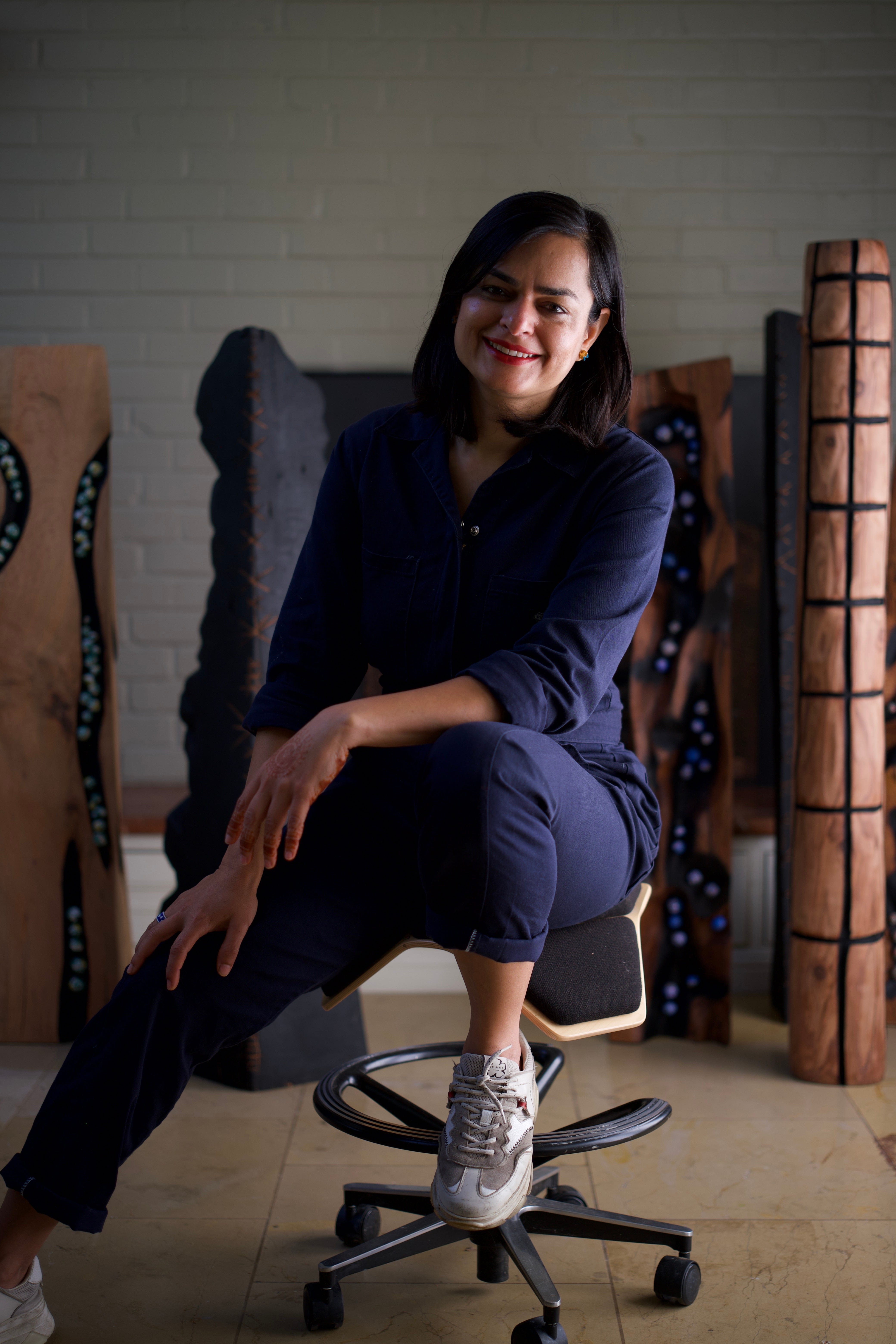
Priyanka Rana’s work struck me immediately because I rarely encounter sculpture that feels this formally modern while still carrying the symbolic, ritual, and ecological textures I associate with South Asian ways of seeing. Her practice moves fluidly between ritual and climate consciousness, memory and material intelligence. Working primarily in wood, Rana creates sculptures that feel both ancient and distinctly modern - charred, carved, stitched, hollowed, and at times bound with vivid sari thread. Across the work, wood is never passive material. It arrives with history, resistance, and its own intelligence.
Rana’s sculptures hold multiple temporalities at once: the lifespan of a tree, the violence and tenderness of human intervention, the memory of migration, the possibility of healing.
Seeing Rana’s use of sari thread, I kept thinking about the symbolic life of tying thread to trees and other acts of binding as gestures of protection, devotion, and hope. In India, those meanings run deep, including in practices where trees are consecrated with thread as part of collective vows of care and stewardship. At Purvai Rai’s opening at Rajiv Menon Contemporary, Rai shared a similar connection to how acts of tying string and sowing seeds as small acts of hope, meditative gestures that ground you in the present while offering something toward the future. Rana’s use of thread carries some of that same charge. In her work, these gestures are never ornamental. They are intimate acts of relation.

Read on for our full conversation.
Was there a moment when working with wood stopped feeling like “material” and started feeling like a collaborator?
Yes. That was a turning point in my practice. I began to honor the memories and history of the wood. Instead of hiding cracks or seeing them as flaws, I started embracing them.
I remember working with an untreated log, grinding it down to remove infestations. I was frustrated because it felt like nothing would be left after a full day’s work. But when I stepped back, I saw a beautiful abstract form. It felt like a partnership with the bugs, which had in some way led me toward that shape. That was when I realized the wood would participate and bring its own history with it. Reading about other wood sculptors, like David Nash, also deepened my understanding of the material.
You speak about attunement to wood. What does listening look like in practice?
I sometimes pivot from the concept I had in mind depending on how the grain responds to a particular form. Wood is such a beautiful material that, while working with it, I am always asking whether I am adding to what is already there.
I often char my pieces, but with one redwood sculpture I decided to keep it raw once I finished shaping it. Redwoods have a high concentration of tannin, which gives the heartwood its golden-red hue. When I taper a log, I am able to reach that tannin-rich heartwood. After seeing the variation in color across the piece, I realized it needed to remain raw rather than undergo controlled charring. Clearly, that is what the piece was asking for.
Are there times when a piece resists you? What do you do when the material’s intelligence contradicts your initial intention?
I often come across a shape that resists what I have in mind. When that happens, it leaves me with an uneasy feeling that I take to bed with me. I have learned to lean into that feeling and make micro-adjustments to the form. Often, it is the smallest changes that make the biggest difference.
I have also used illusion to reach the shape I want. My first sculpture was a sphere, and I wasn’t happy with the form, so I sliced it, creating the illusion of a continuous line. Charring can also help make a form feel more supple while masking some irregularities. If I am truly stuck, I use clay to make a small maquette so I can better understand the reductions I need to make.
You’re trained in mathematics and economics. Where does that analytical training still show up in your sculptural decisions today?
Sculpting is mostly problem-solving. You are always analyzing center of gravity, torque, and balance, especially with larger works. That requires an analytical mindset.
Your work holds multiple temporalities — growth rings, charring, stitching, healing. How conscious are you of time while working?
All the time. Wood as a material contains epochs of time within it. The species I work with, especially redwoods, can live for thousands of years. They have been on this planet longer than humans have. So yes, time plays a great role in my work.
Is there a piece that taught you something only after it was finished?
One of my largest works was a commission from the city of Dublin. It was a thousand-plus-pound log, more than six feet long and around five feet wide. I hollowed it out and installed steel wires on the top rim so it would carry the feeling of a musical instrument.
It was a daunting task to complete on my own. I would literally sit inside the log to work on it. Once I finished it, I realized that if I keep working on something every day, I can do what initially feels impossible.
How does your thinking change when a work enters public space or a civic context?
I think of public sculptures as birds — a sign that a place is well loved. When I approach public art, I am always thinking about engagement. I attend local city meetings, visit the sites, and read about the place so I can become familiar with the location and the community.
I also like to involve local communities in public art, whether through interaction with the sculpture itself or by inviting them to contribute to its making. In two public projects, local community members contributed old toys that I installed within wooden forms. Those toys spoke to lineage. For instance, someone donated a toy shaped like a peacock. It was clear that it had traveled from South Asia, speaking to the migrant community in that area. I also sourced the wood locally for those projects.
What does responsibility look like to you when working with land, community, and ecology at scale?
I come from a community of farmers, where connection to land is emotional. I feel the same way about trees. Each tree carries its growth rings, and those rings are like a map of ecology worn on the body. The circles that I highlight through carving and controlled charring tell us about the climate conditions the tree lived through.
I am always aware of that while working with wood, and I feel it is my responsibility to bring that forward and help people see trees differently.
You’ve lived across continents. How do those geographies live inside the work, even when they aren’t explicitly referenced?
Living across different continents, the one thing I could always count on carrying with me was memory. The idea of memory comes up frequently in my practice.
In Indian cultural frameworks, trees are often seen as sentient beings. How did that belief shape your practice early on, and how has it shifted living in California?
To be honest, I did not begin with that mindset, even though it was present in the culture around me growing up in India. The more I investigated this material and the deeper I went into my attachment to it, the more my practice began to converge with both ancient ways of seeing and modern knowledge: that trees are intelligent and sentient. They live in communities, help one another, parent their young, and evolve in response to their environments.
Drawn to work like Priyanka’s? Take the LOTA Art Style Quiz to discover the kinds of art you naturally respond to.
Do you feel your work is translating something between cultures, or creating a third language altogether?
Yes. My work carries the way of seeing and living that I absorbed while growing up in India, together with the materials and material knowledge that came from living in California. You could say it is creating a third language in the process.
I would argue that this new language is also universal and easily accessible. Controlled charring, for instance, is very ritualistic for me because fire plays a key role in Indian ceremonies. But in California, fire also carries the meaning of climate change. Those ideas blend together and create a new meaning in the work.
When you add materials like sari threads, thorns, or fabric, what changes emotionally or symbolically for you?
Everything. Each material brings its own tactile memory, and the way I need to handle it changes too. Even between thread and fabric, the emotional reaction is different. Wrapping thread around wood feels more ritualistic, while making memory pods with fabric feels closer to a craft passed down through generations.
Charring, stitching, piercing — these gestures feel both violent and tender. How do you think about harm versus care in your work?
Care appears frequently in my work, but it comes with tension. I created a series about healing when both my husband and I had to undergo surgery. I realized there were healing rituals I had grown up with but had since forgotten. These sculptures became reminders that healing is a gift that needs to be opened slowly.
For the first sculpture in that series, I used a chainsaw to make cuts in a nine-foot-long piece of wood laid flat on the floor. Later in the series, the sculptures stood vertically, and I used a handsaw to make cuts that felt more like sutures or scars. I also think about the expectations we place on ourselves, and I have used rose prickles harvested from my backyard in the work.
Looking back five years, what belief about your practice have you let go of?
Working with wood is rewarding in many ways — the joy of creating, the intuition of the material, even the beautiful smells that accompany the work. But it can also be physically demanding. I am a prolific artist, and in the beginning I pushed my body hard. Now I work at a more sustainable pace: I stretch, I take breaks.
In the beginning, I saw wood as something I had to control and shape. I have learned instead to see it as a participatory material. It will shift and move even after I have stopped working on it, and that is part of what makes it so unique.
Is there a risk — material, conceptual, or emotional — you haven’t taken yet but feel drawn toward?
I am drawn to the possibility of animating my sculptures with smell, video, and audio. I do not yet know how I want to do that, but I feel pulled toward it.
What question is currently guiding you in the studio?
Branches. Lately, I take every chance I can to look at branches and ask myself what they are saying. It is clear to me that they are asking us to play.
I am experimenting with the idea of extension — how branches reach outward, defying gravity while staying rooted.
Fast Three
A color that keeps returning — and what it signals for you
Black. It absorbs everything and helps you focus on what is essential.
One non-art object in your studio you keep nearby — and why
A photo of my kids when they were babies. It reminds me how fast they are growing.
An artist or thinker who has quietly influenced your work
David Nash, for his approach to wood. Ruth Asawa, for her approach to living a full life as an artist, mother, and community member. And Noguchi, for his curiosity.
Thank you to Priyanka for sharing her story and practice with LOTA. You can follow her wok on Instagram or learn more through her website.
P.S. New here? Start with the art quiz to discover your style.


