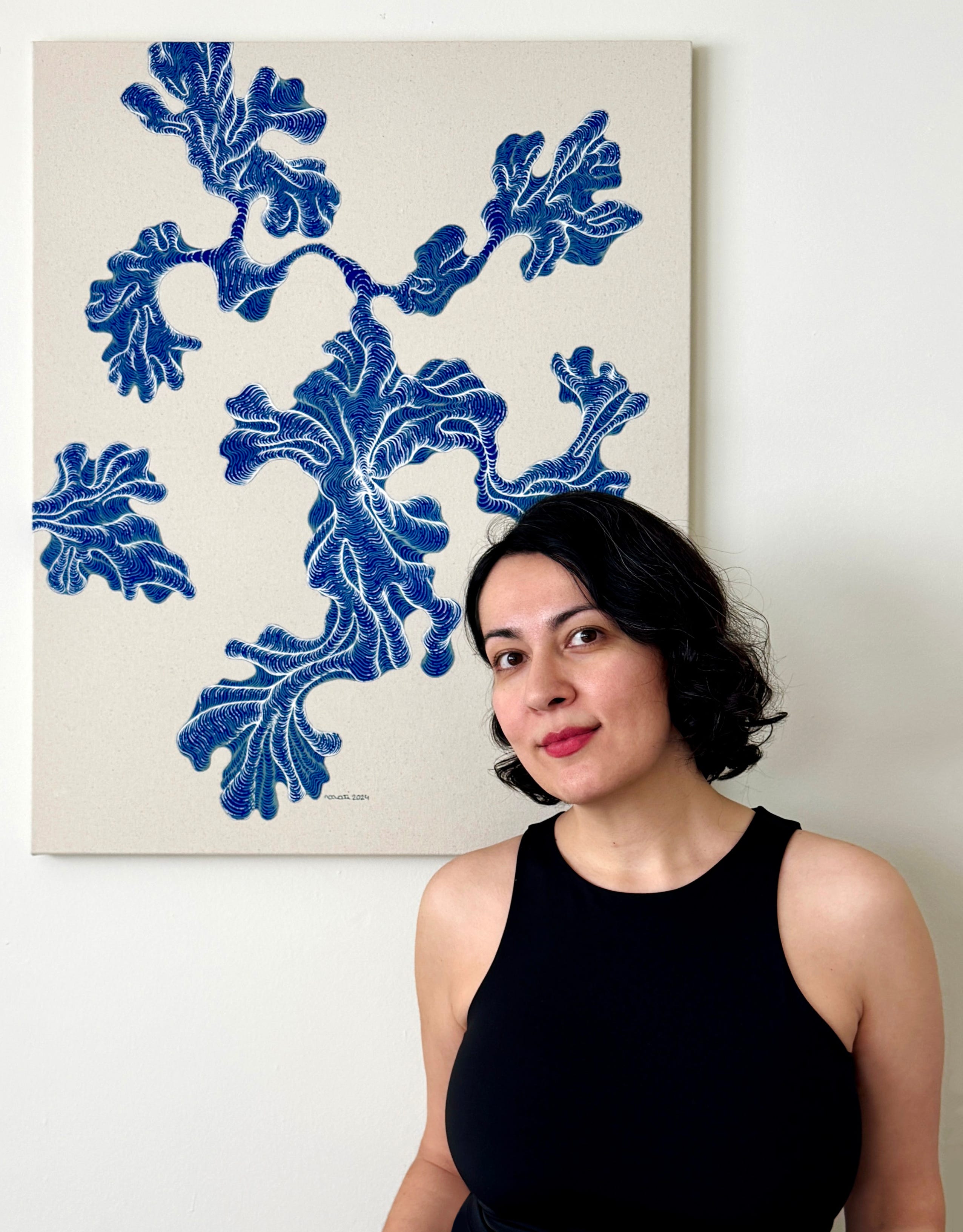
“I think of my work as existing in the space between two truths: nature appears chaotic on the surface, but underneath it is highly structured, precise, and measurable. That hidden order fascinates me.” — Artist Moti Tavassoli
When I saw Tavassoli’s work at The Other Art Fair a few years ago, I was completely mesmerized. Walking through rows and rows of artist booths, the colors and composition caught my eye. I expected it to be landscape art or some form of abstraction, but as I got closer, I didn’t expect it to feel so scientific and topographical.
So I started chatting with Moti and learned that the works visualize the invisible networks of plant life—the nutrients moving through mycelial networks underground, the chemical signals plants send each other, the way information travels through a single plant.
Ok, back up. How did we get here?
I needed to know more, so today I’m excited to share a conversation with Tavassoli about how she came to create these worlds of plants, how growing up in Iran and moving to LA shaped her relationship to nature, and, of course, what this all means for where her work is headed.
Let’s get into it.
When did nature become your “home base”?
Some of my earliest memories are tied to nature — family trips to the lush forests of northern Iran and summers at my grandfather’s orchard, harvesting mulberries with my extended family, eating sour cherries straight from the tree while the juice ran down my arms. Those moments were brief but grounding. Otherwise, we lived in the heart of the city with little access to nature.
The moment it truly clicked came during college in San Luis Obispo. After an especially difficult evening, I went on a solo sunrise hike. As the sun lifted the fog off the hills, I saw a deer grazing peacefully. It was completely quiet except for the subtle sounds of the landscape. In that stillness, I felt myself soften. By the time I walked back down, I felt lighter, clear-headed, and able to move forward.
Everything around me was in slow but constant motion—the sun rising, the fog drifting, the deer moving through the field. That sense of gentle, continuous movement has stayed with me and often appears in my work through line and form.
As someone who moved from Iran to Los Angeles, I experienced a deep sense of rootlessness. Nature became the one place that felt stable, neutral, and accepting. Today, I return to it through weekly hikes and daily walks, observing plant life, collecting textures and colors, and grounding both my life and artistic practice in that relationship.
You trained in architecture and design. How does that influence your studio practice now?
First, thinking in essence and abstraction.
In design, I was trained to move beyond the literal and identify the underlying concept or system at play. In my art practice, that translates into distilling what I observe—whether it’s plant growth, decay, or networked systems—into forms, lines, and gestures that hold multiple layers of meaning rather than direct representation.
Second, attention to tactility and visual language.
Material, texture, repetition, and pattern deeply matter to me. Whether I’m working in clay, fiber, or pigment, I’m constantly testing how texture reads up close and at a distance, how light interacts with a surface, and how repetition creates a sense of harmony or tension.
Third, systems thinking and modularity.
I often approach creating as defining a unit and then aggregating it through a set of rules—similar to how a product or architectural system is developed. This allows forms to emerge through process rather than total control. It mirrors ecological systems and plant networks, where individual parts create complex wholes.
Ultimately, my design background gives me a structured way to explore intuition—balancing systems and experimentation to create work that is both rigorous and alive.
Your work balances precision with much more fluid, atmospheric forms. How do you think about that?
I think of my work as existing in the space between two truths: nature appears chaotic on the surface, but underneath it is highly structured, precise, and measurable. That hidden order fascinates me.
My training in architecture and human-centered design taught me how to synthesize complex systems and translate them into visual, digestible forms. I bring that same approach into my paintings. I’m not trying to represent nature literally—I’m trying to make its invisible intelligence legible and felt.
I use systematic line work, repetition, and structure to suggest those underlying systems, while allowing color, gesture, and material to remain fluid and responsive.
You talk about the “intelligence of plant life.” How does that show up in the work?
The “intelligence of plant life” shows up in my work through line, rhythm, and structure as a way of visualizing invisible processes.
In different paintings, lines stand in for different forms of plant communication—sometimes they trace the movement of nutrients through mycelial networks between roots, sometimes the spread of chemical signals within a species, and sometimes the way information travels through the body of a single plant.
These lines are repeated gestures rather than literal diagrams. Broken lines feel slow and steady, continuous lines feel fast and forceful; dense passages suggest speed or intensity, while sparse marks feel like drift or evaporation.
I think of the compositions like flocks of birds or schools of fish—local interactions that produce a larger, emergent system.
I don’t assign fixed visual codes to specific plant processes; the translation is intuitive. My goal is not to illustrate science literally but to make its intelligence felt.
What does the research behind that look like?
Books were my entry point into this world. While talking about my houseplants with a colleague, they recommended The Botany of Desire by Michael Pollan. Learning that plants can shape their own evolution by domesticating humans completely shifted my perspective.
From there, The Hidden Life of Trees, The Light Eaters, Underland, and The Serviceberry have each offered different ways of understanding plant life, its intelligence, and our relationship to it.
Alongside reading, walking is central to my research. Weekly hikes and daily walks to my studio are part of my practice, allowing me to observe shifts in color, blossoming, decay, and invasion over time. I collect fallen plant parts, document color relationships I see in flowers, and record patterns and textures in plant bodies.
These observations go directly into my sketchbook as drawings, small sculptures, and color studies. In the studio, I translate these observations into material—sometimes literally, sometimes in an abstracted way—through clay and surface work.
Ultimately, I share this research through my work by visualizing and embodying scientific ideas—making visible the unseen exchanges and systems that plants inhabit and create.
What question are you chasing next?
What does it mean to be in a balanced relationship—with nature, with material, and with the systems we participate in—and how can that be made visible through form?
On one level, that’s leading me deeper into sculpture and spatial installation. I’ve been working more in clay and I’m interested in scaling up—creating pieces that don’t just sit in space but create an environment the body can move through, the way we move through landscapes or ecological systems.
At the same time, I’m researching the relationships humans choose to form with nature—models of reciprocity, care, and coexistence that contrast with extractive systems. I’m asking what we can learn from plant communities about cooperation, communication, and long-term thriving, and how those ideas can be translated into visual and spatial language.
And finally, I’m turning that question back onto my own practice: what is my relationship to my materials? Am I choosing them intentionally, in alignment with my ideas and values, or defaulting to what is convenient or readily available?
All of these threads come back to the same inquiry: how can my work embody the kind of relationships I want to see in the world—interconnected, responsive, and alive.
Love Moti’s work but not sure what would work in your own space? Art Office Hours is a one-hour session built around one room or one specific art question.
LOTA Fast Three
A color you can’t quit — what does it do inside your work?
Blue—both Ultramarine and Cerulean. Those hues feel simultaneously grounding and otherworldly. I find myself reaching for them when I want a sense of quiet and calm that is expanding at the speed of light.

Studio object — one non-art thing you keep nearby?
An oxtail bone I found in my pho. Its form is strangely sculptural—intricate, functional, and balanced. The smooth surfaces where the bone is exposed contrast beautifully with the crinkled joints where it once connected to another.
I keep it close because it reminds me of a boney orchard—organic structures repeating themselves in mysterious, elegant ways.
An artist who inspires you — who, and what do they teach you?
Ruth Asawa. The gorgeously complex forms she created from the simple act of looping wire feel endlessly inspiring to me. There is something powerful about how she transformed a repetitive gesture into structures that are both delicate and grand.
Her sculptures feel like rhythm suspended in space—they occupy space while also creating it, all the while allowing other things to breathe and be.
She was also incredibly prolific across media, constantly experimenting and pushing the limits of her materials. That spirit of curiosity and play is something I try to carry into my own work. She was deeply inspired by nature, and I’m drawn to how her work echoes organic growth, cellular structures, and natural systems.
Thank you to Moti for sharing her practice with LOTA. You can follow Moti’s work on Instagram, learn more through her website, or see available works here.
Photos courtesy Moti Tavassoli unless noted otherwise
P.S. New here? Start with the art quiz to discover your style.
More from LOTA
What I'd Buy Under $500
I was having dinner with a group of friends a few weeks ago, catching up on work, when I mentioned a recent project I had wrapped. A friend asked, “Okay, but can you get real art with fewer zeroes?”
An Art Collection Can Start with One Wall
I get a lot of questions about where to start with art collecting - what to spend, what size to look for, where to even begin. One recent client is a perfect example of how you can start small, make a big impact, and continue to hone your style and taste a…
What I’d Buy From Summer Group Shows
Summer group shows are categorically fun. Caught somewhere between the end of the spring solo season and the Fall openings, summer show are looser with galleries bringing together artists who might not otherwise share a room. They test new names, pull out smaller or stranger works, and take chances they may not take in serious buying season.


